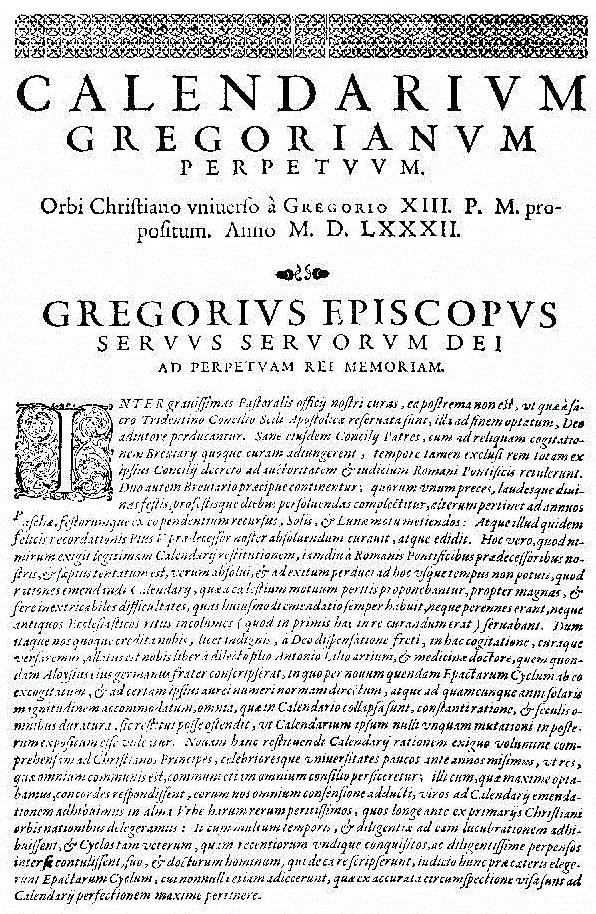
Pope Gregory XIII's calendar reform corrected an accumulated ten-day error in the Julian calendar, which had drifted out of sync with the solar year since Roman times. Catholic countries including Spain, Portugal, and the Italian states adopted it immediately, so that in these lands October 5th through the 14th, 1582, simply never happened. Protestant and Orthodox nations held out for decades or centuries longer.
For centuries, the Julian calendar had been quietly losing time, drifting roughly one day off every 128 years because its assumed year length was slightly too long. By the 1500s the spring equinox, crucial for calculating Easter, had slipped ten days from where it should fall. Pope Gregory XIII, acting on calculations by the astronomer Aloysius Lilius, decreed a fix.
The solution was almost comically blunt: erase ten days outright. In Spain, Portugal, and much of Italy, residents went to sleep on October 4, 1582, and woke up on October 15. Merchants had to renegotiate interest and rent calculations; some laborers reportedly rioted, believing their lives had literally been shortened.
The change exposed Europe's religious fractures. Catholic nations adopted the Gregorian calendar swiftly, but Protestant England held out until 1752, and Russia clung to the Julian calendar until the Bolsheviks abolished it in 1918 — which is why the 'October Revolution' actually took place in November by the Gregorian reckoning.
Key people: Pope Gregory XIII, Aloysius Lilius