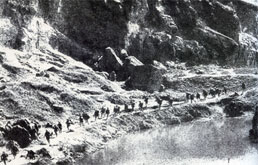
As Japanese armies pushed deeper into northern China in the fall of 1937, Chinese Nationalist and Communist forces mounted a rare coordinated defense around Taiyuan, including the Communist-led Eighth Route Army's ambush at Pingxingguan weeks earlier. The fighting around Taiyuan in October showcased the ferocity of Japan's advance and the staggering cost the Chinese population would pay across eight years of war.
By October 1937, Japan's invasion of China, launched in July, had already produced horrific casualties as Japanese forces swept through the north. The Battle of Taiyuan, fought for control of the Shanxi provincial capital, drew in a rare alliance between Chiang Kai-shek's Nationalist troops and Communist forces under Zhu De and Peng Dehuai, united temporarily against the common invader.
The surrounding campaign included the Battle of Xinkou, one of the war's bloodiest early engagements, where Chinese forces inflicted serious casualties on the Japanese but ultimately could not hold the line. Japanese artillery and air superiority proved decisive, and Taiyuan fell in early November despite fierce resistance.
The fighting in Shanxi that October foreshadowed the pattern of the entire war: Chinese forces, often poorly equipped, would trade enormous casualties for time, slowing but rarely stopping Japan's advance. The Second Sino-Japanese War would eventually claim an estimated 15 to 20 million Chinese lives before folding into the wider conflagration of World War II in 1945.