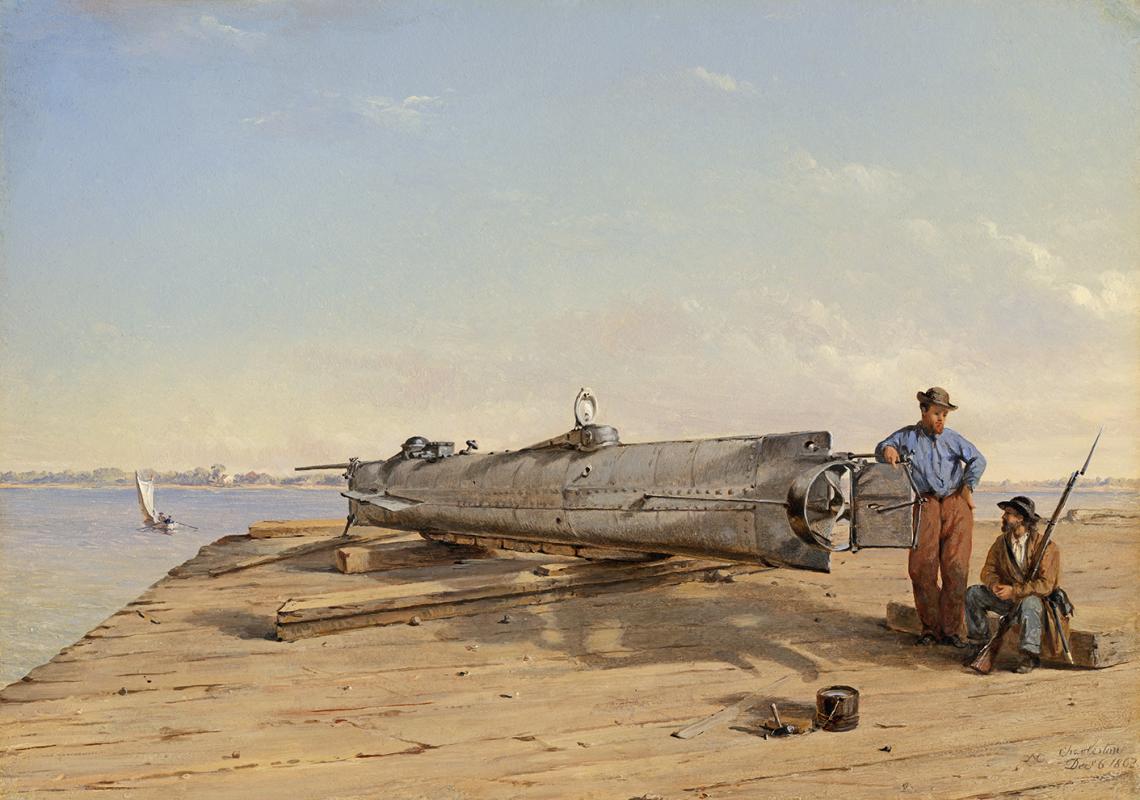
The Union blockade was strangling Charleston, and the Confederacy gambled on a hand-cranked iron submarine to break it. On the night of February 17, 1864, Lieutenant George E. Dixon and seven crewmen drove the Hunley toward the sloop-of-war Housatonic and detonated a torpedo mounted on a spar against her hull. The Housatonic went down with five of her crew. The Hunley never came home: she sank with all eight men aboard, and her fate stayed a mystery for more than a century.
The Hunley was a death trap before she ever saw an enemy. Two earlier sinkings during trials had killed 13 men, among them her namesake and financier, Horace Lawson Hunley. Still, volunteers kept climbing into her cramped hull, where eight men turned a crankshaft by hand in near darkness while the commander steered and worked the diving planes.
On February 17, 1864, the gamble paid off. The torpedo on the Hunley's spar tore into the Housatonic, which sank off Charleston within minutes. Because the water there was shallow, most of her crew survived by climbing into the rigging, and five men died. The submarine and her eight-man crew then disappeared.
Divers found the wreck in 1995, and it was raised in 2000. Inside, archaeologists found a gold coin belonging to Dixon, bent by the Union bullet it had stopped at the Battle of Shiloh two years earlier. He had carried it as a good-luck charm, and it was still with him when he died.
Key people: George E. Dixon, Charles W. Pickering, Horace Lawson Hunley