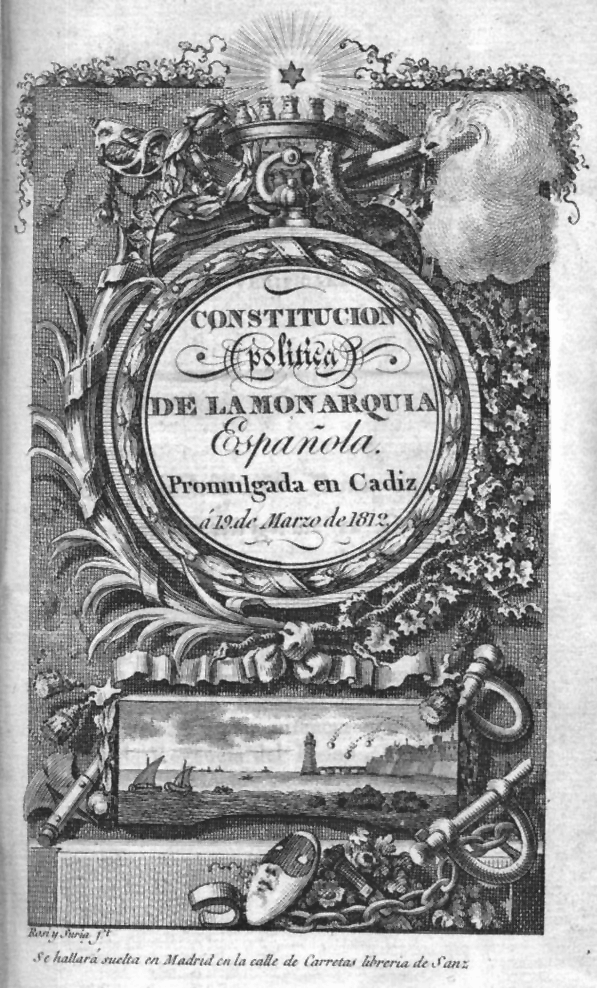
Napoleon's armies occupied most of Spain, and the Cortes that met in Cádiz included deputies from Spain's American colonies and the Philippines. Their constitution established a constitutional monarchy, separated powers, broadened suffrage and abolished seigneurial privileges. Because it was proclaimed on the feast of Saint Joseph, it was nicknamed "La Pepa". King Ferdinand VII abolished it on his return in 1814, but it became a model for liberal movements across southern Europe and Latin America.
In 1812 Cádiz was one of the few places in Spain beyond Napoleon's reach, protected by the sea and a British fleet while French artillery shelled it from across the bay. Inside, a parliament of priests, lawyers, officers and merchants set out to remake the Spanish monarchy. Among them were about 60 deputies from Spain's American territories.
The document they produced, with 384 articles, declared that sovereignty resided "essentially in the nation" rather than in the king. It created a single-chamber parliament, set up an independent judiciary and guaranteed freedom of the press, though Catholicism remained the only permitted religion. It was proclaimed on March 19, 1812, Saint Joseph's Day, which gave it its popular nickname, the diminutive of José.
Ferdinand VII, restored in 1814, tore it up and jailed many of its authors. It came back to life in the liberal revolution of 1820 and again in 1836, and it inspired constitutions in Portugal, Naples and Piedmont. The word "liberal" itself entered political vocabulary through the Cádiz reformers, the liberales.
Key people: Agustín de Argüelles, Diego Muñoz-Torrero