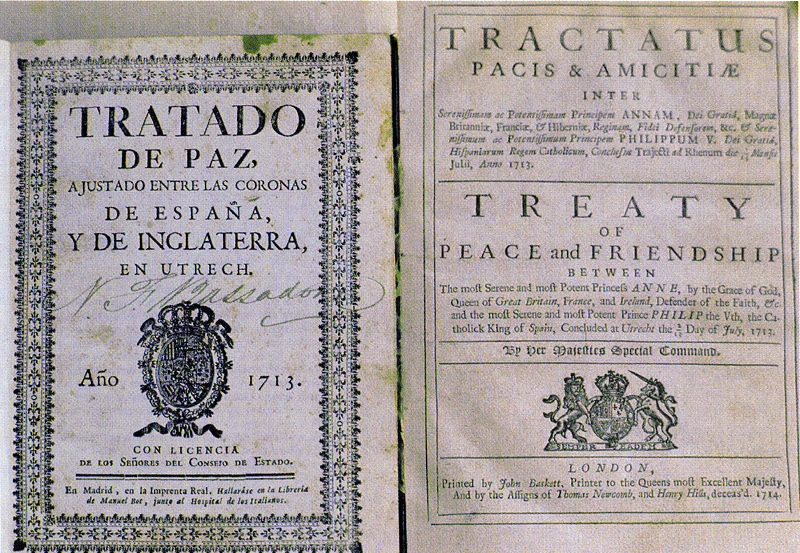
The war had begun in 1701 over who would inherit the Spanish empire after the childless Charles II. The treaties signed on April 11, 1713, recognized Louis XIV's grandson Philip V as King of Spain, on condition that the French and Spanish crowns never be united. Britain gained Gibraltar, Minorca, Newfoundland, Nova Scotia and the Hudson Bay territories, and, in a separate deal, the asiento, the right to supply enslaved Africans to Spanish America. The settlement established a European balance of power.
By 1710 the war had cost hundreds of thousands of lives in battles from Blenheim to Malplaquet, and Britain's new Tory government wanted out. Its ministers, led by Henry St John, later Viscount Bolingbroke, opened secret talks with France, to the fury of Britain's allies. The Duke of Marlborough, the war's great British general, was dismissed. Formal negotiations began in the Dutch city of Utrecht in January 1712.
The main treaties, signed on April 11, 1713, allowed Philip V to keep the Spanish throne but required him to renounce any claim to France's, and the French princes to renounce Spain. Spain's European empire was divided: its territories in the southern Netherlands and Italy went mostly to Austria, although Austria itself did not make peace until the Treaty of Rastatt in 1714. Savoy received Sicily.
Britain emerged as the great winner. Besides territory in the Mediterranean and North America, it obtained the asiento, a 30-year monopoly on supplying enslaved Africans to Spain's colonies, which was granted to the South Sea Company. The treaties made the idea of a balance of power a stated principle of European diplomacy.
Key people: Louis XIV, Queen Anne, Philip V of Spain, Henry St John, 1st Viscount Bolingbroke