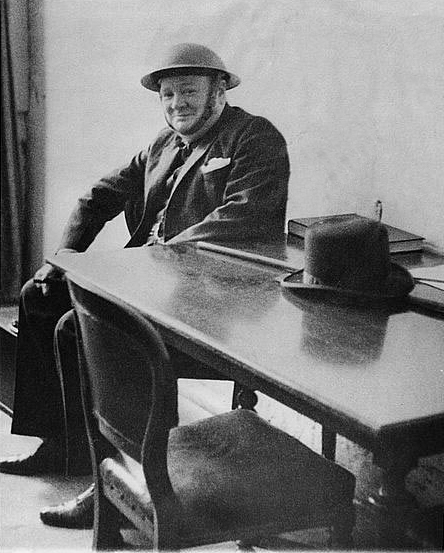
Churchill asked the House to express confidence in his new coalition government as German armies advanced through the Low Countries. In a speech of only a few minutes, he defined his policy as "to wage war, by sea, land and air, with all our might" and his aim in one word: "victory". The House approved the motion by 381 votes to none. The speech was the first of his wartime addresses and set the tone for Britain's resistance.
Churchill had become prime minister on the evening of May 10, 1940, the day Germany invaded the Netherlands, Belgium and Luxembourg. Much of his own Conservative Party still preferred Neville Chamberlain, who remained party leader, and when Churchill entered the Commons on May 13 he received a cooler welcome than his predecessor.
The speech was short. "You ask, what is our policy?" Churchill said. "I can say: It is to wage war, by sea, land and air, with all our might and with all the strength that God can give us." Asked his aim, he answered: "Victory, victory at all costs, victory in spite of all terror, victory, however long and hard the road may be; for without victory, there is no survival." The phrase "blood, toil, tears and sweat" echoed words used by earlier writers, including Theodore Roosevelt.
The speech was not broadcast live; it was read on BBC radio later. Within weeks Churchill would deliver two more famous addresses, "We shall fight on the beaches" on June 4 and "This was their finest hour" on June 18.
Key people: Winston Churchill, Neville Chamberlain