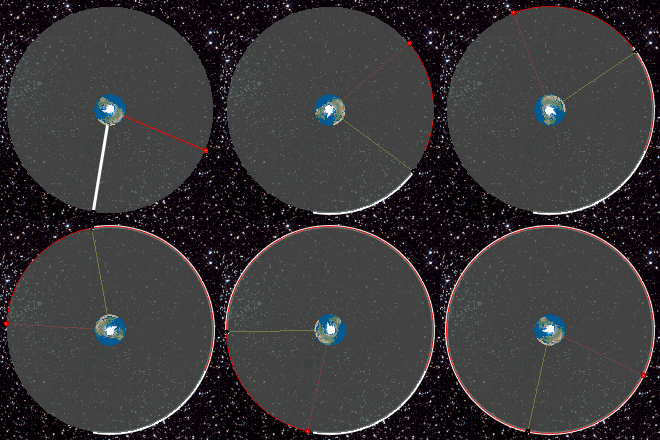
Unlike its predecessor Telstar, which orbited too quickly for continuous coverage, Syncom 2 matched Earth's rotation, allowing it to hover over a fixed longitude. Its success proved the viability of geosynchronous satellites, paving the way for the global communications and broadcast infrastructure that followed.
Hughes Aircraft engineer Harold Rosen had spent years pushing the seemingly quixotic idea of a geosynchronous communications satellite against skepticism from NASA officials who favored a constellation of low-orbit satellites like Telstar. Syncom 2's successful launch aboard a Delta rocket from Cape Canaveral vindicated his approach.
Though Syncom 2 wasn't perfectly geostationary—it drifted north and south in a figure-eight pattern rather than sitting motionless over the equator—it proved a satellite could match Earth's rotational period, staying continuously visible from ground stations without complex tracking. The satellite relayed a telephone call between President Kennedy and the Nigerian prime minister within days of reaching orbit.
The technology matured rapidly: Syncom 3 achieved true geostationary orbit the following year and broadcast the 1964 Tokyo Olympics live to the United States. Rosen's persistence had effectively invented the architecture underlying modern satellite television, GPS timing signals, and global telecommunications.