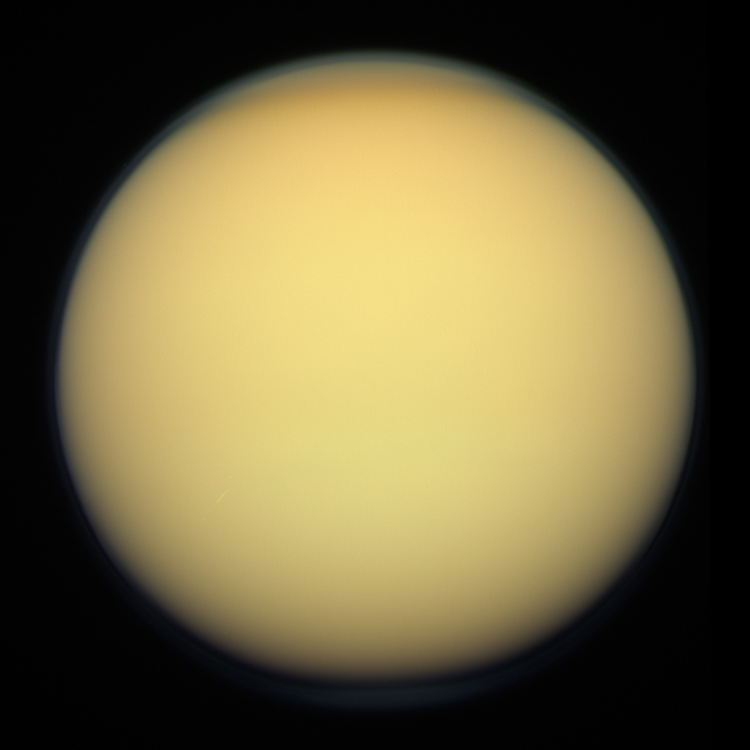
On March 25, 1655, Christiaan Huygens observed a point of light orbiting Saturn and correctly identified it as a moon, later named Titan. His discovery, made with telescopes he ground and designed himself, was the first moon found orbiting Saturn and helped confirm that other planets, like Earth, could have satellites, bolstering the Copernican model of the solar system.
In 1655 Christiaan Huygens, the son of a prominent Dutch diplomat and poet, was in his mid-twenties and more interested in lenses than in politics. Working with his older brother Constantijn, he had taught himself to grind and polish glass, and the pair built a refracting telescope about 12 feet long that magnified roughly 50 times, sharper than most instruments of the day. Turning it toward Saturn, Huygens noticed a faint star near the planet. Over the following nights it moved with Saturn against the background stars and shifted its position around it. It was a moon, the first one found anywhere since Galileo spotted four circling Jupiter in 1610.
Huygens tracked the new satellite until he could estimate its orbit at about 16 days, remarkably close to the modern figure of just under 16. In 1656 he announced the find in a short pamphlet, De Saturni Luna Observatio Nova. Tucked into it was a scrambled string of letters, a cipher common among scientists who wanted to claim priority without revealing an unproven idea. Decoded in his 1659 book Systema Saturnium, it read, in Latin, that Saturn is surrounded by a thin, flat ring that touches it nowhere. That solved the puzzle of the planet's strange shifting ears, which had baffled Galileo. Huygens simply called his discovery Saturn's moon. The name Titan came nearly two centuries later, from the astronomer John Herschel in 1847.
The discovery strengthened the Copernican case that Earth was not unique in having a satellite, though Huygens drew one conclusion that aged badly. With six known moons matching six known planets, he suggested the tally might be complete. Giovanni Domenico Cassini found a second Saturnian moon, Iapetus, in 1671, and Saturn is now known to have well over a hundred. Titan itself proved stranger than Huygens could have imagined: larger than the planet Mercury, wrapped in a thick nitrogen atmosphere, and dotted with lakes of liquid methane. In 2005 a European probe named Huygens parachuted through that haze and landed on its surface, the most distant landing ever achieved by a human-made spacecraft.