Emperor Hadrian ordered the wall built to secure the Roman province of Britannia from tribes to the north and to formally mark the boundary of Roman civilization. Stretching 73 miles from coast to coast, built largely by three legions over roughly six years, it stood as one of antiquity's most ambitious frontier projects. Its milecastles and forts remain among Britain's most visited archaeological sites.
Church records place Bach's baptism in the Georgenkirche in Eisenach around this time in 1685, just days after his birth on March 21 under the Julian calendar then in use. Though the precise date sits at the edge of documentary certainty, the event marks the formal entry into recorded life of a composer whose fugues, cantatas, and concertos would become foundational to Western classical music.

Following the Constitutional Convention's signing ceremony in Philadelphia on September 17, the finished document moved toward the states on September 18, beginning the fierce ratification debates between Federalists and Anti-Federalists. Those arguments, aired in pamphlets like The Federalist Papers, shaped how Americans would interpret their new government for centuries. Ratification required approval from nine of thirteen states, a threshold reached by June 1788.

Amid Napoleon's occupation of Spain and the collapse of royal authority, Santiago's cabildo formed a governing junta loyal in name to the deposed King Ferdinand VII but effectively autonomous. The date, later celebrated as Chile's Fiestas Patrias, did not bring immediate independence — that took until 1818 and years of war — but it opened the era of criollo self-rule that ended three centuries of Spanish colonial administration.

Physicist Léon Foucault suspended a 28-kilogram bob on a 67-meter wire beneath the dome of the Panthéon, demonstrating that the plane of the pendulum's swing appeared to rotate relative to the floor — actual proof that the floor, and the Earth beneath it, was turning. Crowds gathered daily to watch the slow, silent rotation, a piece of public science theater that made an abstract Copernican fact suddenly, viscerally undeniable.
The paper promised readers it would not be "violently" partisan and aimed for a measured, factual tone unusual for the sensationalist press of the era. Renamed The New York Times in 1857, it grew into one of the most influential newspapers in the world, eventually winning more Pulitzer Prizes than any other publication and helping to define standards of American journalism.
An estimated magnitude 8.2 earthquake struck central Chile on the eve of national independence festivities, devastating Valparaíso and Santiago and killing between 3,000 and 20,000 people according to varying estimates. Fires that followed the shaking compounded the destruction, and the disaster prompted Chile's first serious efforts at modern seismic building codes.

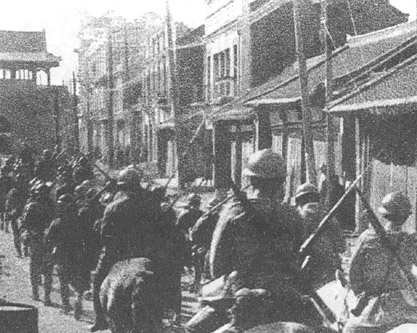
Lieutenant Kawamoto Suemori of the Japanese Kwantung Army detonated a small charge on a section of track belonging to the South Manchuria Railway near Mukden. Barely damaging the line, the explosion nonetheless became the pretext for a full military occupation of Manchuria within months. The League of Nations condemned Japan's aggression, but toothless sanctions did nothing to stop the march toward the Second Sino-Japanese War.
Under the National Security Act of 1947, the U.S. Army Air Forces became the independent United States Air Force, with W. Stuart Symington sworn in as its first Secretary. The change reflected lessons from World War II, where strategic bombing and air superiority had proven decisive, and set the stage for the Air Force's central role in the nuclear-armed Cold War standoff that followed.

"The Man Trap" introduced American television audiences to Captain Kirk, Mr. Spock, and the starship Enterprise. Gene Roddenberry's vision of a diverse, optimistic future — built on a shoestring budget with cardboard sets — struggled in the ratings during its original run and was nearly cancelled after two seasons, only to become one of the most influential media franchises in history through syndication.

Launched only three weeks earlier, Voyager 1 turned its camera back toward home from a distance of about 7.25 million miles, producing the first single image showing both Earth and its Moon. The photograph, though modest by later standards, hinted at the spacecraft's larger destiny: it would go on to photograph Jupiter and Saturn's systems in stunning detail before crossing into interstellar space in 2012.
