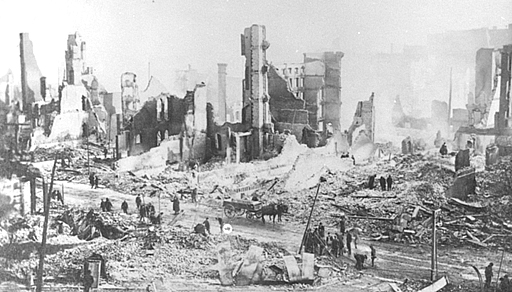
The blaze started in the basement of the John Hurst & Company building on February 7, 1904, and burned until the next day. It destroyed more than 1,500 buildings, severely damaged about 1,000 more and caused an estimated $100 million in property losses. Help poured in by rail from other cities, and 1,231 firefighters eventually brought the fire under control. Many of the visiting crews found that their hoses would not fit Baltimore's hydrants. That failure led directly to the first national standard for hose couplings.
The fire probably started when a cigar or cigarette fell into the Hurst basement. Within hours it was beyond the city's control. Fire Chief George Horton sent a telegram to neighboring cities: "Desperate fire here. Must send help at once." Engine companies arrived by train from Washington, Philadelphia, New York and beyond. When they tried to connect to Baltimore's hydrants, many found the threads did not match. Crews stood by with working pumps and no way to use them while the downtown business district burned.
By the time the fire died out, about 140 acres of central Baltimore had been destroyed, and some 35,000 people had lost their jobs. It was the most destructive American fire since Chicago in 1871.
The mismatched couplings were the lesson people remembered. In 1905 a committee of the National Fire Protection Association set a standard diameter and thread count for hose couplings and hydrants, the ancestor of today's NFPA 1963. Adoption was slow, though. A century after the fire, only 18 of the 48 most populous American cities had installed the national-standard hydrants. Baltimore rebuilt its downtown in fireproof materials and was one of the cities that switched to the standard.
Key people: George Horton