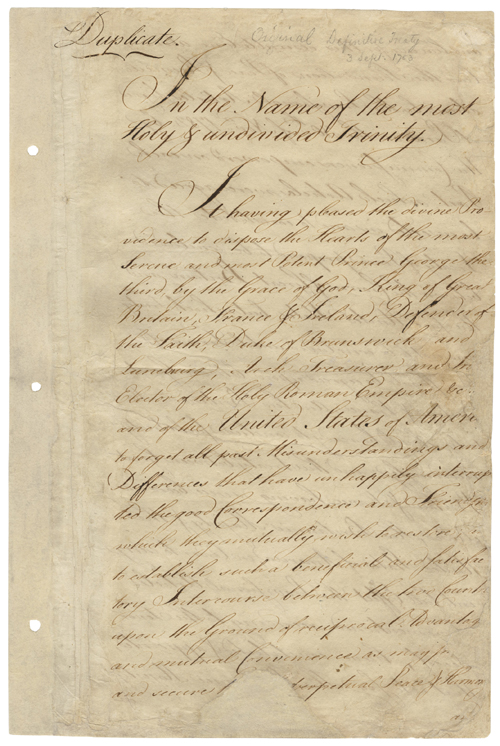
American negotiators John Adams, Benjamin Franklin, and John Jay secured British recognition of the thirteen former colonies as a free and sovereign nation. The treaty set the new nation's boundaries stretching to the Mississippi River, granted fishing rights off Newfoundland, and required Congress to recommend that states restore property to Loyalists — a promise seldom honored.
Signed at the Hôtel d'York in Paris, the treaty brought a formal close to eight years of war that had begun with shots at Lexington and Concord. The American delegation had skillfully played Britain against its own allies France and Spain, negotiating directly with the British rather than through the French foreign ministry, much to the annoyance of Paris.
The terms were remarkably generous to the fledgling United States. Britain ceded vast territory west to the Mississippi River and north to the Great Lakes, far more land than the Americans had ever effectively controlled. British negotiator Richard Oswald, a former slave trader, worked opposite Franklin, who had spent years in Paris cultivating French support and now pivoted to securing peace.
Back in America, news traveled slowly across the Atlantic. General George Washington did not learn of the treaty's signing for weeks, and British troops did not fully evacuate New York City until November 25, celebrated ever after in that city as "Evacuation Day."