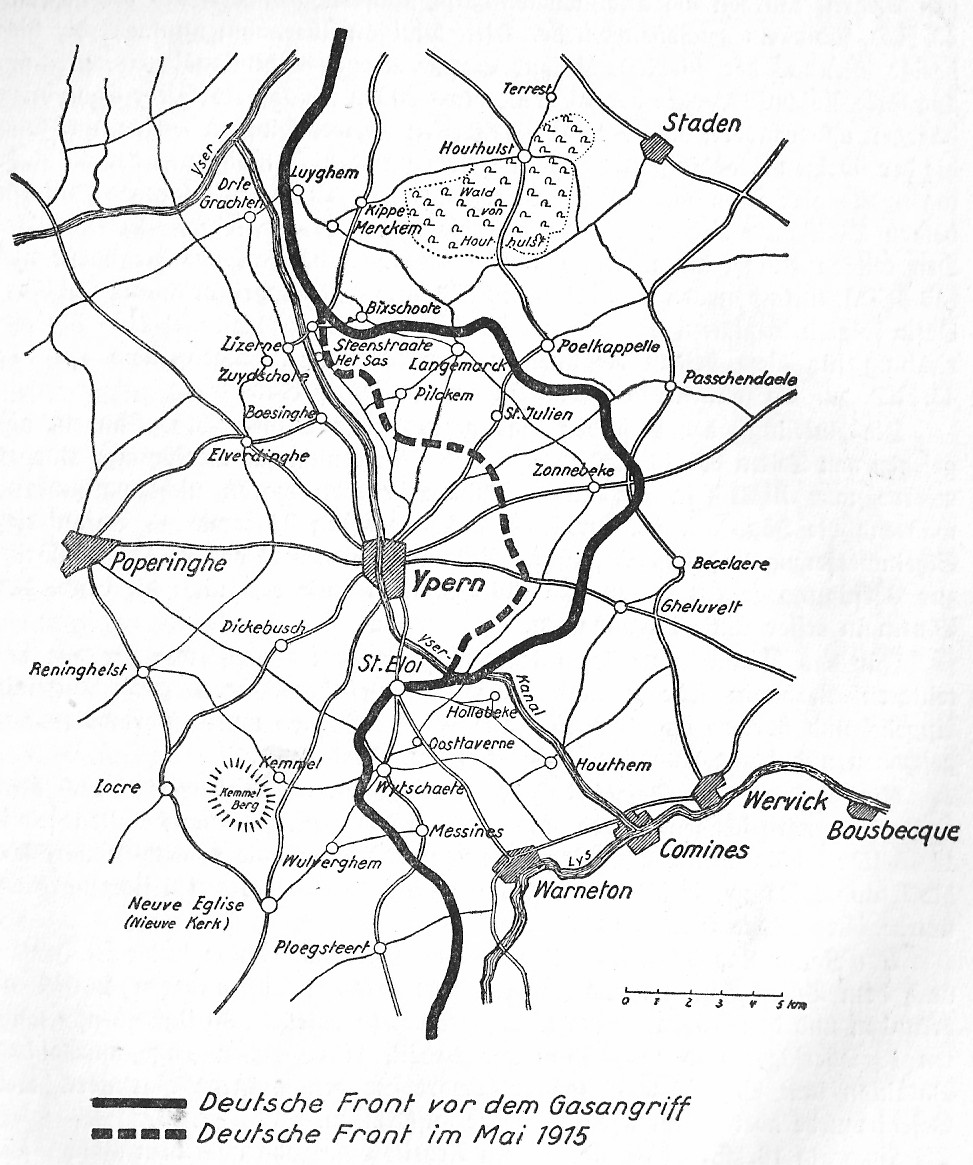
Late in the afternoon, German soldiers opened some 5,700 cylinders along a front of about four miles. A yellow-green cloud drifted over trenches held by French colonial and territorial troops, who fled or died choking. The attack opened a gap in the Allied line, but the Germans had not prepared to exploit it, and Canadian troops helped close the breach over the following days. Chemist Fritz Haber had supervised the attack. Both sides soon used gas routinely.
Fritz Haber, a chemist who later won a Nobel Prize for synthesizing ammonia, proposed releasing chlorine from cylinders and letting the wind carry it into enemy trenches. The method avoided a strict reading of the Hague Conventions, which banned projectiles filled with poison. German engineers buried thousands of cylinders in their front line near Ypres and waited weeks for a favourable wind.
It came on April 22, 1915. At about 5 p.m. the valves were opened, and a cloud rolled across no man's land toward Algerian and French territorial troops. Chlorine reacts with water in the lungs to form acid, and men caught in the cloud gasped, choked and died. Survivors fled, leaving a gap several miles wide. The German infantry advanced cautiously behind the gas and stopped for the night.
Over the next days, Canadian troops, some protecting themselves with cloths soaked in water or urine, held the line in bitter fighting. The Second Battle of Ypres lasted until May 25. Britain used gas at Loos that September, and by the end of the war poison gas had caused about 1.3 million casualties.
Key people: Fritz Haber, Albrecht of Württemberg